
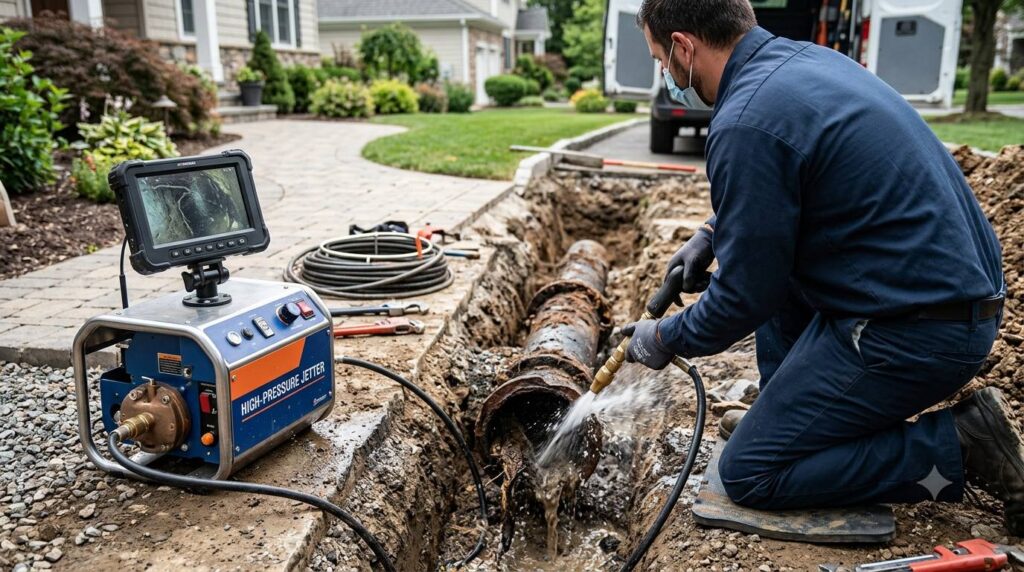

Traditional drain cleaning methods clear many everyday clogs caused by hair, grease, soap scum, or minor debris. A plumber’s snake or hydro-jetting equipment often restores flow quickly and at a reasonable cost. Yet some drainage problems return within days or weeks, or the cleaning process itself reveals that the blockage is only a symptom of a deeper issue. When repeated treatments fail to produce lasting results, the underlying cause usually lies inside the pipe wall or beyond the reach of standard tools.
In those situations, a detailed sewer camera inspection becomes the most reliable way to see exactly what is happening underground and determine the correct next step.
Why Standard Cleaning Sometimes Falls Short
Mechanical snakes and water jets excel at punching through or flushing out soft obstructions. They cannot, however, repair a cracked pipe, remove a heavy root intrusion that has already compromised the pipe wall, or realign a section that has settled and created a belly. If the clog is caused by a collapsed segment, a protruding tap, or a foreign object lodged in a joint, the cleaning tool may temporarily open a path only for the problem to reappear as soon as more waste accumulates.
Homeowners often notice a pattern: the drain runs freely for a short time after service, then slows again. Multiple service calls produce the same temporary improvement. At that point continuing to clean without diagnosing the structural condition of the line simply treats the symptom while the real defect continues to worsen.
Clear Signs That Cleaning Alone Will Not Solve the Issue
Several practical indicators suggest the problem has moved beyond ordinary clogging. Recurring backups in the same fixture or the same section of the house, especially after recent professional cleaning, rank high on the list. Multiple drains backing up simultaneously often point to a main sewer line issue rather than an isolated branch clog. Foul odors that persist after cleaning, gurgling sounds in toilets or showers when other fixtures are used, and soggy patches or sinkholes in the yard above the sewer route all raise the likelihood of pipe damage or blockage that cleaning tools cannot fully resolve.
Older homes with clay, cast-iron, or Orangeburg pipe are particularly prone to these deeper problems. Roots seek out small cracks or loose joints, then expand until they obstruct flow or break the pipe. Soil movement, heavy vehicles, or simply decades of use can shift sections out of alignment and create low spots where waste settles and hardens.
How Video Inspection Changes the Diagnosis
A sewer camera inspection uses a flexible rod fitted with a high-resolution waterproof camera and LED lights. The camera is fed into the cleanout or an accessible fixture and pushed through the line while the operator watches a live video feed. Distance counters and locators allow the technician to note the exact position of any defect relative to the house or yard.
The recording typically reveals the true condition of the pipe: cracks, offsets, root masses, grease buildup that has hardened into a thick lining, corrosion scale, or sections that have begun to collapse. Because the image is visual and recorded, both the technician and the homeowner can see the evidence rather than relying on assumptions based solely on how the cleaning tool felt.
This level of detail prevents unnecessary or incomplete repairs. Instead of repeatedly jetting a line that has a major structural failure, the homeowner receives a clear recommendation—whether targeted repair, pipe lining, or full replacement—based on actual conditions inside the pipe.
Common Problems Revealed Only by Camera
Root intrusion ranks among the most frequent findings. Even after roots are cut away by an auger, the camera often shows that the pipe wall is already fractured, so new roots will return quickly. Bellied pipe, where a section has sunk and created a low area, allows solids to settle permanently; no amount of flushing permanently corrects the geometry. Separated joints, common in older clay systems, permit soil and roots to enter while allowing wastewater to leak out. Corrosion in cast-iron lines can leave thin, brittle walls that crack under normal use. In some cases the camera discovers a previous repair that was poorly executed or materials that have reached the end of their service life.
Each of these conditions explains why traditional cleaning produced only short-lived improvement. The camera turns guesswork into documented fact.
When to Request an Inspection Instead of Another Cleaning
If a drain has required professional cleaning more than once in a relatively short period, an inspection is usually the more economical next step. The same applies when cleaning tools encounter hard resistance that feels like a solid obstruction rather than soft buildup, or when the technician reports that the cable or jet could not reach the expected distance. Visible signs in the yard, repeated backups that affect more than one fixture, and homes with known aging sewer materials also justify moving directly to camera diagnosis.
Waiting until a complete blockage or a sewage overflow occurs often increases both the urgency and the cost of the eventual repair. Early visual confirmation of the pipe’s condition allows repairs to be planned rather than performed under emergency conditions.
What Happens After the Inspection
Once the video has identified the problem and its location, the homeowner receives a realistic range of options. Minor root intrusion in an otherwise sound pipe may be managed with periodic cutting and chemical root treatment. Localized cracks or small offsets can sometimes be addressed with trenchless pipe lining or spot repair. Longer sections of damaged pipe may require replacement, either by traditional excavation or by trenchless methods that minimize disruption to landscaping and hardscape.
Because the camera recording documents the exact situation, decisions rest on evidence rather than estimates. Many homeowners find that the clarity provided by the inspection more than offsets its cost by eliminating repeated cleaning calls and preventing more extensive damage.
Preventing Future Surprises
While not every pipe failure can be avoided, certain habits reduce the load on aging sewer lines. Avoiding grease disposal down kitchen drains, limiting flushable wipes and other non-degradable items, and addressing slow drains before they become full backups all help. For homes with mature trees near the sewer route, periodic camera checks can catch root activity early. Knowing the material and approximate age of the underground lines also helps set realistic expectations for remaining service life.
Conclusion
Traditional drain cleaning remains the right first response for many ordinary clogs. When the same problem returns repeatedly or when additional warning signs appear, continuing to clean without looking inside the pipe rarely produces a lasting solution.
A clear view of the line’s interior condition transforms an ongoing frustration into a defined, solvable problem. Seeing exactly what is wrong allows homeowners to choose the repair that actually matches the damage, restore reliable drainage, and avoid the cycle of temporary fixes that never quite resolve the underlying issue.